Thursday, July 11, 2013

Beaverton Creek Vine Maple Trail ,continued

Not knowing exactly how the bottom layer will come out after it has been superimposed, I decided to err on the cautious side and painted in most of the scenery, except for the obvious foreground.  I also did this bottom layer with a more exaggerated tone.  My theory was that this way the bottom layer would reveal itself better.


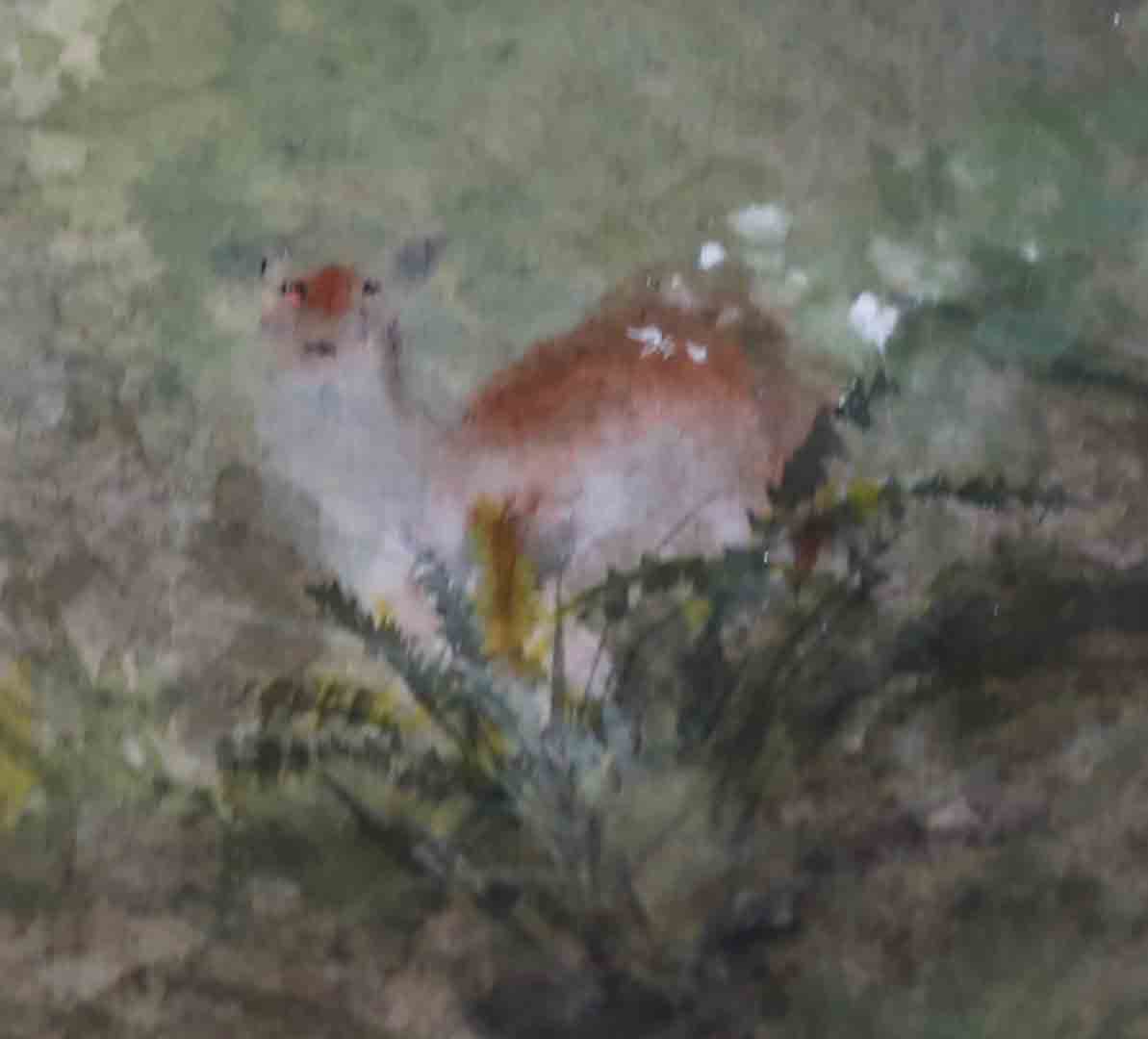
Then I decided to add a little interest to the work by painting in something dear, a Deer (bad pun).


Now it is time to do the top layer.  I put my translucent Xuan on top of the bottom painting, and begin adding in foreground information.

It didn't  take me long to discover a new problem.  What I was viewing through the top layer is not what it would look after the 2 pieces are glued together.  Gluing the two would have eliminated the air gap between them and illustrate the bottom layer much better.  In the mean time, I could only guess.

So I stopped and wet down the top Xuan, just to get a more educated view of the bottom.

 
I hoped to integrate the top layer better with the bottom layer.  I was hoping for a gradual transition from foreground to background.

Wanting to make sure that my deer is not so hidden, I re-painted it on the top layer for insurance.

 
This was how it looked when the 2 layers were mounted together.  While still wet, thus the color was more vibrant, and the paper seemed more transparent.


Then I found out what it is like when the 2 layers were misaligned by just a millimeter.  The eyes on the deer have migrated to the top of the head, instead of being lined up with the bottom edge of the ears!

Frantic reworking on the top layer solved that problem.

The painting lost some of its lustre after it was dried.


An application of gel medium brings back some of that color depth.


I was not too unhappy with the end result.  I wish I could have done a much better job on these trees.  Those are awful awful brushstrokes.  I forgot about "writing" them in and I am not proud of them.


I also realized that no matter how saturated the background colors were, they just don't show through enough to make a difference.  So for background information, it is better to be either succinct dark lines or large patches of color without intricate details.  I also discovered the color on the top Xuan really obscures whatever is on the bottom layer.  In order for the bottom layer to show through, I'll just have to have faith and do not embellish the top layer over the same spots.

Wednesday, July 3, 2013

Beaverton Creek, Vine Maple Trail

Vine Maple Trail is the main path that leads to Beaverton Creek from the parking lot.   It is a paved blacktop that enjoys filtered sunlight and cooler temperature in the summer and non soggy, non slippery surface in the rainy season.  It is my playground, my gym, my treadmill.

There is this bend in the road where boughs from opposite sides of the road embrace each other to form a series of archways.  With the morning fog and the low angle of light, it is simply ethereal.

I recently got a hold of some really thin and translucent Xuan.  The kid in me urges me to experiment with it.  I wanted to see if I could reassemble this image of depth and light and shadows by using this Xuan as a layer, as in photo editing .

So on this "background" layer, which is a fiber board with glued on canvas, I started to write down what I considered background information; footprint of the trail, trees in a distance.


There was a large fir tree flanking the right side of the trail.  At first I was ambiguous as whether to treat it as background or top layer.  But then I thought what the heck, I laid it down anyways.  If I wasn't happy with it sitting in the background, I could paint it again on the top layer.  Perhaps the 2 layers combined would give it more depth? 


Just to be sure, I found a partially painted piece of this special Xuan and laid the vacant portion over the fir tree.  It did not show through at all, to my horror!  Then I wet down the Xuan to make it more translucent.  Now the bottom image is coming through! 


So this little test validated my concept of top and bottom layers and now I can forge ahead.  My next concern is whether the bottom layer will come through like the way I envisioned it to be.  After all this is not not Photoshop where I can adjust the degree of opacity of the different layers.

Saturday, June 22, 2013

Beaverton Creek Napolean

I can fondly remember the Napoleon ice cream in my days as a kid growing up in Hong Kong.  Strawberry, vanilla and chocolate flavors in pink, white and brown stripes.  The challenge was how to savor the treat for the longest duration before it melted away in the non-air-conditioned room.

I did the 3 styles of Beaverton Creek ( Beaverton Creek, Beaverton Creek Yellow, Beaverton Creek Classical ) to hopefully answer my own question; What is Chinese Brush painting.

I know I had discussed this topic in my last few blogs, I thought I would use these 3 pieces to illustrate my assertion.  The givens were, all three were done using Chinese brush and pigments on Xuan.


The most impressionistic of the 3 belongs to this one done in green.  The painting exudes a strong "feeling" that is abstract and yet tactile at the same time.  One can almost paddle the kayak through the water and be mesmerized.  Aside from the split hair and splash ink technique, it does not look very Chinese.  I'll submit this work looks more western than Chinese, despite Chinese brushes being employed.


There is definitely a lot more traditional Bi-Fa in the Beaverton Creek Yellow although the composition is not very Chinese.   It should be evident that the artist had  training in Chinese Brush landscape and uses "chuen" and contour lines to describe shape and topography.  Some of the lines depicting stalks and trunks showed center tip calligraphic characteristics.  So can we consider this one under Chinese Brush painting, even when its composition is identical to the top one?  Must a Chinese Brush painting look traditional?  When is this a "watercolor" as some might call it and not a Chinese Brush painting?


I am sure not a lot of people would have problem classifying this as a Chinese Brush painting.  So what is different about this one?

Granted the bridge was absent from the other two, but that does not make this more Chinese than the others.

We can't get very far from this discussion without addressing Bi-Fa again.  I still think this is the quintessential element in defining Chinese Brush painting.  One must show not only the presence, but the craftsmanship of the brushstrokes.  The traditional brush rendition of shrubs and shores helped to cement this in the Chinese Brush painting category.

We mentioned the Three Perspective concept in traditional Chinese Brush landscape paintings.  This work here employed all three.  The void space at the bottom of the woods in the distance added to the Level perspective.  The meandering shorelines and all the little details along the banks defined the Depth perspective.  Along with height described by the few stands of fir, one gets the birds eye view of Beaverton Creek; thus gently gliding over it, enjoying the little tidbits of information that each section gives off.

The composition falls within a classical doctrine..  a literal translation would be One River Two Shores.  The painting is dissected  somewhat diagonally by the creek, with contrast on both banks. Left bank is more densely vegetated, thus the Yang, The right side would be the Ying.   However the Ying side actually created conflict by harboring the attention grabbing pink trees. Leaves are present only on some of the trees, again creating contrast.   Complementing contrast is harmony;  opposite banks are linked not only by the bridge, but by tree trunks leaning towards each other, by the pink answering the blue, by sharing the ducks.

Although the painting employs many color, the overall feel is not "Su", or ostentatious.

I would not be so crass as to claim that I have thought of all these attributes before I laid my first brushstroke on this painting;  a lot of these points are anecdotal.  The fact remains that much thought has gone into these 3 paintings to raise a point, What Is Chinese Brush Painting.