People here always ask me if I paint on rice paper.
At first I was confounded. What do they mean?
"Oh, you mean Xuan paper?"
I've been trying hard to correct this misnomer until I searched Wikipedia. I am disappointed that the paper which has nothing to do with rice is called rice paper. The term was supposedly coined by Robert Morrison, a missionary back in the 1800's.
The main ingredient for making Xuan paper is fibers from the bark of the Blue Sandalwood. The proportion varies from 40 to 80%. To that is mixed in with fibers from indigenous area, and these may include rice straw, grass straw, hemp, mulberry and bamboo.
The rice paper I grew up with is an edible sheet of dried starch used to package food. I am submitting a picture of a plum paste jelly/walnut snack wrapped with rice paper. The paper shields the outside packaging from the sticky content and saves the consumer from having to peel off the wrapping paper before eating the goody.
How could an ill adopted name from centuries ago survive this long. Was there no one to speak up?
I am just saying. I believe in calling a spade a spade.
I am an enthusiast of Chinese Brush Painting and I would like to share my trials and tribulations in learning the craft. I want to document the process, the inspiration and the weird ideas behind my projects and to address some of the nuances related to this dicipline. I hope to create a dialogue and stir up some interest in the art of painting with a Chinese brush on Xuan. In any case, it would be interesting to see my own evolution as time progresses. This is my journal
Wednesday, September 24, 2014
Monday, September 15, 2014
Sailing
I dropped my laptop and cracked the screen. It now has a cluster of vertical lines on the left third of my screen.
I was mad.
I found myself moving my head from side to side, trying to peek through those vertical lines, as if they were just a mesh screen blocking my view.
It was comical.
I continued my experiments with the semi-sized Xuan.
I painted some sailboats on the ocean; spinnakers, spinnakers, spinnakers. Enough of the serious stuff.
Using center tip, I patiently laid down scores of horizontal lines, lifting with varying pressure and speed. This was calming, almost zen like. A perfect remedy for dealing with the cracked laptop screen.
The paper does not show black well. It appears as sepia.
The painting looked too red to me, although only blue was used.
I remedied that by applying blue color on the back of the paper. The translucent nature of this paper allowed the color from the back to permeate through.
The sail was done with a side tip technique.
The painting became lighter after it dried. The dot in the background was an accident. A happy accident. I somehow managed to drop my brush on the paper. After some laborious blotting and thinning, a smear resulted. Seemed to give reference to a distant landmass. Nice.
I was mad.
I found myself moving my head from side to side, trying to peek through those vertical lines, as if they were just a mesh screen blocking my view.
It was comical.
I continued my experiments with the semi-sized Xuan.
I painted some sailboats on the ocean; spinnakers, spinnakers, spinnakers. Enough of the serious stuff.
Using center tip, I patiently laid down scores of horizontal lines, lifting with varying pressure and speed. This was calming, almost zen like. A perfect remedy for dealing with the cracked laptop screen.
The paper does not show black well. It appears as sepia.
The painting looked too red to me, although only blue was used.
I remedied that by applying blue color on the back of the paper. The translucent nature of this paper allowed the color from the back to permeate through.
The sail was done with a side tip technique.
The painting became lighter after it dried. The dot in the background was an accident. A happy accident. I somehow managed to drop my brush on the paper. After some laborious blotting and thinning, a smear resulted. Seemed to give reference to a distant landmass. Nice.
Saturday, September 6, 2014
All bummed out
I received notification about an exhibition event that I've applied to.
For this application I employed three different treatments of the same subject matter, using different techniques and perspectives. I've posted about these works on my blogs before; it was my quest to explore what really constitutes Chinese brush painting. I've also stated my agenda in my artist's statement when submitting these works for jury. My resolve was to find a public stage to state my case, while instinctively prepare for the real possibility that the judges might not be equipped with the requisite knowledge to discern.
When one looks at a picture of a waterfall with the water looking like a silky ribbon, those not-in-the-know might say "Oh, how pretty". Those in the know would say, " Oh, how pretty, the photographer used a long exposure to achieve that effect." Such is the difference between a juror having the proper knowledge about photography and one who just appreciates. Granted, if the picture is good, then it is good regardless. However, the judge with photography background is able to add another layer into the validation process. If I was asked to judge dogs, I should at least know what qualities to look for in different breeds of dogs, and not just a dog that pulls at your heart and makes good companion.
Regrettably, the piece labeled Traditional Brush got rejected. I don't want to speculate the reason behind it. If I was given a choice, I would rather prefer the traditional brush piece be accepted in lieu of one of the other ones.
The Impression had the least semblance to Chinese brush. Yes it was executed with Chinese brush on Xuan, but that was about it. It was like a child born to Chinese parents but grew up adopted in Deutschland. This kid knew nothing of the Chinese culture, spoke no Chinese and ate no Chinese food. The only thing Chinese about this kid was the the genetic makeup.
The yellow painting was the same adopted kid, but spoke a few words of Chinese. There were hints of a Chinese traditional brushstroke, especially when describing topography and texture of the near shore on the left is concerned.
What was novel about this piece was the fact that alum was used to size certain parts of the paper to create that neither solid nor empty but kind of translucent look, adding a third dimension to the otherwise 2 dimensional feel. These sized areas were represented by the highlights of the trees and the branches. Contrast these voids with the empty spaces of the sky and the water and you'll know what I mean.
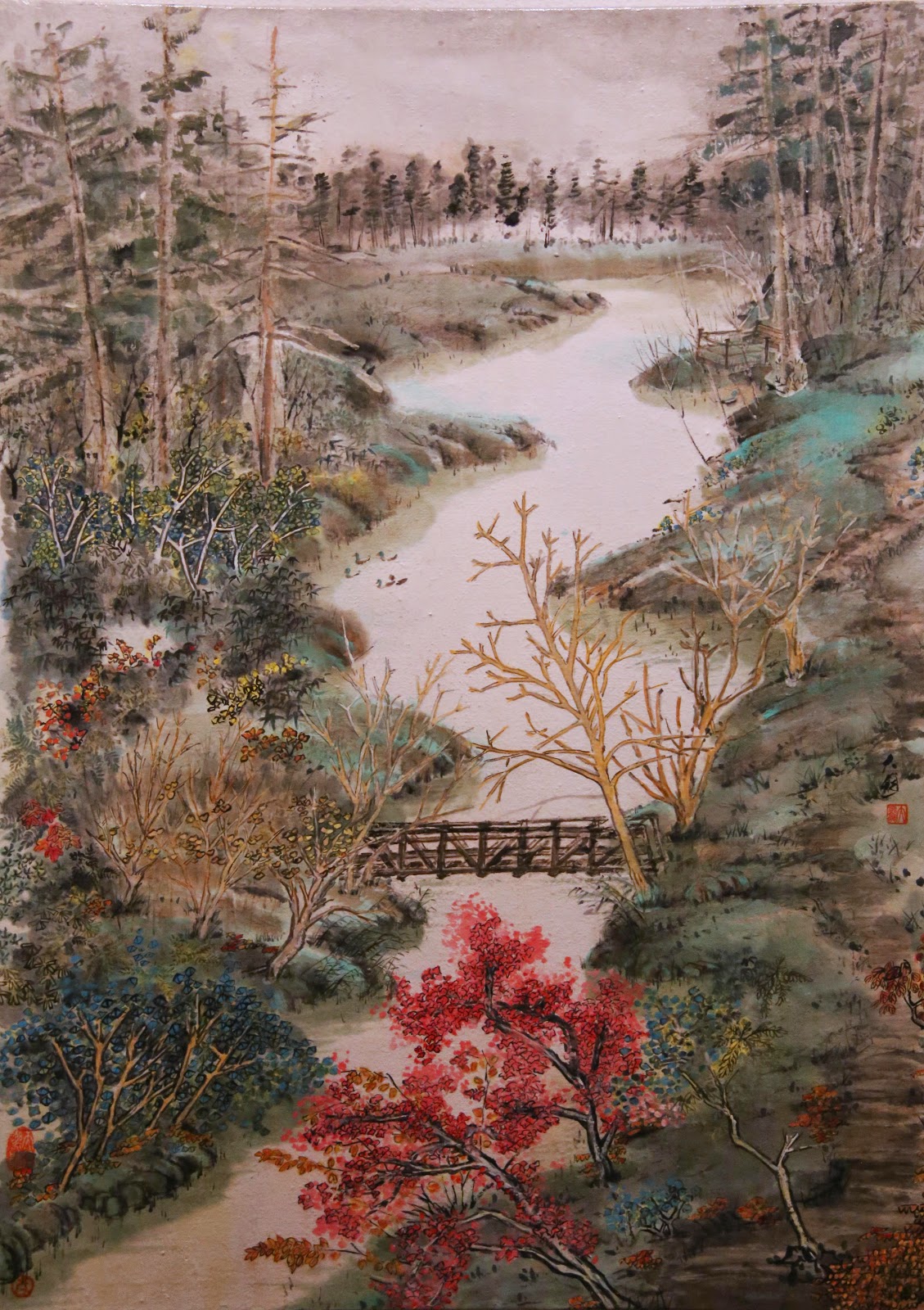
The traditional brush piece was the same adopted kid in Germany but was immersed in the local Chinese culture as well. Therefore she knew the culture, spoke the language, ate the diet, but was not dressed in the traditional Qipao (Cheongsam). The brushstrokes were all traditional, the "chuen" strokes were traditional, the fashion to describe assorted woods was traditional, the multi-layered application of color was traditional. What was not traditional was again the composition, the utilization of alum to accentuate the conifers, and the choice and intensity of the coloration. Where as the painting might lack that je ne sais quoi, it takes someone with Chinese brush acumen to discern it. This kid was trying to be as chinesisch as possible, albeit wearing western garb.
I was really hoping that by showing these 3 pieces together, I would be able to raise the conversation: what is Chinese brush painting. Perhaps this event is not the proper forum.
For this application I employed three different treatments of the same subject matter, using different techniques and perspectives. I've posted about these works on my blogs before; it was my quest to explore what really constitutes Chinese brush painting. I've also stated my agenda in my artist's statement when submitting these works for jury. My resolve was to find a public stage to state my case, while instinctively prepare for the real possibility that the judges might not be equipped with the requisite knowledge to discern.
When one looks at a picture of a waterfall with the water looking like a silky ribbon, those not-in-the-know might say "Oh, how pretty". Those in the know would say, " Oh, how pretty, the photographer used a long exposure to achieve that effect." Such is the difference between a juror having the proper knowledge about photography and one who just appreciates. Granted, if the picture is good, then it is good regardless. However, the judge with photography background is able to add another layer into the validation process. If I was asked to judge dogs, I should at least know what qualities to look for in different breeds of dogs, and not just a dog that pulls at your heart and makes good companion.
Regrettably, the piece labeled Traditional Brush got rejected. I don't want to speculate the reason behind it. If I was given a choice, I would rather prefer the traditional brush piece be accepted in lieu of one of the other ones.
The Impression had the least semblance to Chinese brush. Yes it was executed with Chinese brush on Xuan, but that was about it. It was like a child born to Chinese parents but grew up adopted in Deutschland. This kid knew nothing of the Chinese culture, spoke no Chinese and ate no Chinese food. The only thing Chinese about this kid was the the genetic makeup.
The yellow painting was the same adopted kid, but spoke a few words of Chinese. There were hints of a Chinese traditional brushstroke, especially when describing topography and texture of the near shore on the left is concerned.
What was novel about this piece was the fact that alum was used to size certain parts of the paper to create that neither solid nor empty but kind of translucent look, adding a third dimension to the otherwise 2 dimensional feel. These sized areas were represented by the highlights of the trees and the branches. Contrast these voids with the empty spaces of the sky and the water and you'll know what I mean.
The traditional brush piece was the same adopted kid in Germany but was immersed in the local Chinese culture as well. Therefore she knew the culture, spoke the language, ate the diet, but was not dressed in the traditional Qipao (Cheongsam). The brushstrokes were all traditional, the "chuen" strokes were traditional, the fashion to describe assorted woods was traditional, the multi-layered application of color was traditional. What was not traditional was again the composition, the utilization of alum to accentuate the conifers, and the choice and intensity of the coloration. Where as the painting might lack that je ne sais quoi, it takes someone with Chinese brush acumen to discern it. This kid was trying to be as chinesisch as possible, albeit wearing western garb.
I was really hoping that by showing these 3 pieces together, I would be able to raise the conversation: what is Chinese brush painting. Perhaps this event is not the proper forum.
Beaverton Creek Impression
Beaverton Creek
Beaverton Creek, Traditional brush
My quiet resignation goes out the window; I am all bummed out.
Subscribe to:
Posts (Atom)