Sunday, June 9, 2013

What is Chinese Brush Painting, an artform of lines


A Chinese artist in the 6th century indoctrinated the 6 canons of painting:

1. Rhythm
2. Strength in brush strokes, reflectig the spirit of the artist
3. Fidelity to nature
4. Appropiateness of color
5. Composition
6. Learn by emulation

Thus Chinese brush work is an artform of lines.  It is the brushwork that evokes emotion rather than the object, as evidenced by the relative order of importance suggested above.  Such is the instinct of this eastern artform.

Bi-Fa ( method of the brush ) or Gi Bun Gong ( the fundamentals ) obviously pertains to mastering the brush.  For most Chinese of my generation, brush writing was still taught in school and we sort of took it for granted.  Brush penmanship however is another story.  Student of calligraphy are taught to study and emulate calligraphy by famous masters, in different fonts.  We use a "Te" (template) as our study material.  The goal is not to make a tracing of these brushstrokes but to study them and "read" the intricacies.  This is when we learn how to use the tip, edge and belly of the brush to effect different shapes.


I am going to use just part of a character here to illustrate my point:


In this example, we start at

1. with the tip of the brush, forming the thin sliver
2. traverse with even pressure and speed to form a line of uniform width
3. stop, and the right side edge of brush forms the straight edge here
4. lift brush towards 10 o'clock, leaving the little corner as evidence of the brushstroke, then bring
    brush down in a continuous loop to
5. start with the tip of brush again
6. traverse down with increasing pressure, to form a line with gradually thicker profile
7. stop, allow the belly to fill the delta at the 4 o'clock position;  the left side edge of brush forms the
    straight edge   
8. lift brush towards 10 o'clock, again leaving the little pointy corner as evidence, loop the brush in
    the air towards 9
9. start a new downward stroke, showing the tip of the brush

Calligraphy is like choreographed dance steps; one can make connections from one pose to the next.
Writing with a brush does not mean wantonly putting a bunch of lines together to form a legible character!

 sample of my calligraphy


to be continued

Saturday, June 8, 2013

What is Chinese Brush Painting

What is Chinese Brush Painting?  I suppose this is a rhetorical question, or is it?

Can a painting done with oil painting brushes but carries a Chinese motif be called a Chinese Brush Painting?  How about doing Monet's Water Lilies using Chinese brushes, can the resulting work be called a Chinese Brush Painting?

In Chinese societies, one would use the term "Guo Hua" (Guo means national, Hua means painting; to paint) to describe traditional Chinese Brush Painting.  Guo Hua is done with a round brush, using ink or pigments, mixed with water and painted on Xuan(Hsuan) paper or Juan(silk).  The finished painting is signed off with seal(s) and mounted either on paper or silk and presented as scrolls, or more recently, in frames.

Aside from the perfect complement of the Xuan(Hsuan) paper as a writing medium, the Chinese brush shoulders perhaps the most vital role in the discipline of Guo Hua.  It has a round body that come to a point.  The mission is how to coordinate the strands of hair to the point, and with the belly of the brush to form lines with various thickness and shapes.  Chinese use the brush for their calligraphy; thus calligraphy and painting are firmly intertwined.  In fact, the Chinese often use the term to "write" a painting to describe the act of painting, and the audience is urged to "read" a painting.  This symbiotic relationship has led to the term "Shu Hua" (calligraphy, painting) to describe the 2 commonly linked art forms and exhibition halls in museums catering to the art of Shu Hua.

Bi-Fa (Bi means writing instrument, Fa means the method) describes the nuisances of mastering the brush.  Bi-Fa is also known as Gi Bun Gong (the fundamentals) in some circles.  Think of the fingers holding the brush as the A-arm of a car's suspension.  Our job is to load the brush with the correct amount of water/ink/pigment, with the help of correct camber angles and toe-in, apply suitable pressure and speed, such that the tip, or edge, or the belly of the brush, or combinations of such, form a desirable footprint on the Xuan or Juan.  In other words, keep the tire on the road, mitigating sand, gravel, sleet, rain or snow, taking into account speed and tire pressure.  Thus one can spin wheel, drive, skid, drift, brake or even induce wheel hop.  Sounds complicated?  Well, when we drive most of us have an awareness of whether the road is slippery, or if we have run over something and we instinctively adjust our driving to the road conditions.  We are at ease because we know what our equipment can and will do.

In order to properly "read" a painting, the audience need to be equipped with some basic knowledge of Guo Hua so they can be literate in this subject.  Obviously Bi-Fa is at the center stage.  We demand artists to show calligraphic characteristics in their brush strokes.  Virtues  of the line, how ink or color is dispersed are all important.

This example shows lively ink tone, deliberate yet free strokes.  Ink should have 5 tones, and lines should demonstrate "Li"(strength).  This is the difference  between a motionless live snake and a dead flaccid one, even though both trace the same lines.


Examples of writing with different parts of the brush.  Whether this is an egret or heron is not important.  What is important is the brushstroke and the attitude.


(to be continued)

Wednesday, June 5, 2013

Beaverton Creek (classic) completion

I know I have done a "what if" scenario by painting in pink leaves/flowers on the trees in the foreground using Photoshop; but that was before most of the incidentals were painted in and colored.
Now that I could see the finish line, I'm having second thoughts.

I am leery that pink might be too flashy.

There's only one way to find out.  I painted a couple of test swatches, one in pink and the other Blue Hue Three.


The blue looked nice and seemed to blend in well with the rest of the scenery.  Hence the problem.  It blended in too well and the painting looked ....uninviting.

The pink was uplifting and definitely grabbed my attention.  It worked well as a punctuation mark!  Now the fat lady sings!

 pink it is
 
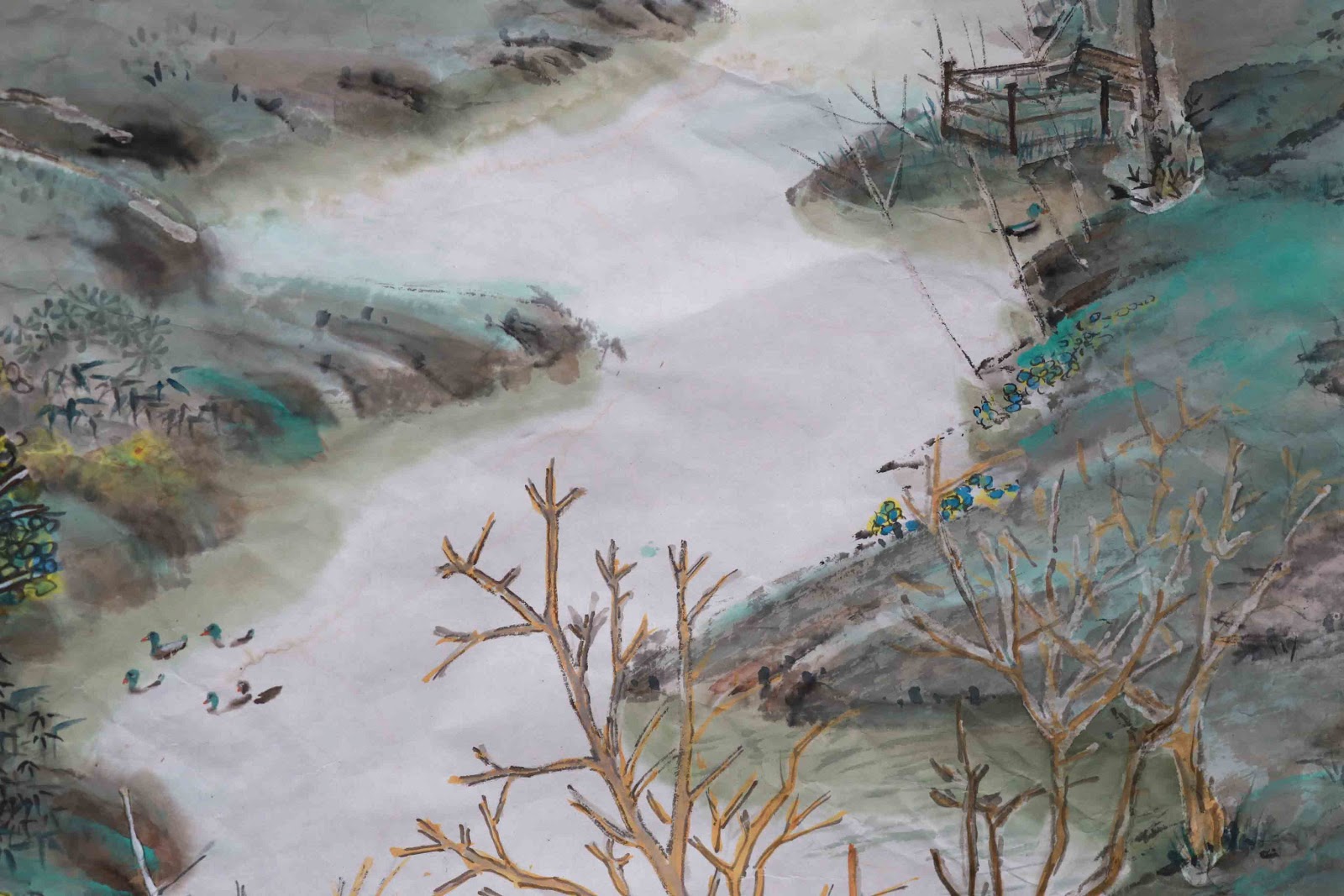
The objects in the near ground were done mostly "boned"; with outline to give them a more defined, crisp footprint.  I tried to create the sense of a diverse and mixed shrubbery by punching up the color palette and painting in leaves of various species; avoiding the sense of total chaos at the same time.  Fortunately I've been to this place a hundred times and I had a pretty good idea in my head.  As one travels further back into the painting, the images became "boneless", edges were not well defined, and the color became more monochromatic.  I actually employed alum solution to help create the white margins around tree trunks.  This worked particularly well for objects in the distance, where a dark outline would be too crisp for the purpose and should be avoided.   I suppose I would call this alum technique as a "soft bone" technique.  Obviously this required planning;  the tree trunks were among the first items to be painted with alum.

The bamboo areas in the left midriff portion seemed a little flat.  I tried to paint in a few more leaves but that looked really cluttered and was concealing my brushstrokes, so I backed off.  I settled on selectively darkening certain areas to give it a lumpy look, to get  more depth in that cluster.


 bamboo treatment

The creek still looked too open ended for me.  I would like the bottom part to close off some more.  I also wanted to warm up the foreground somewhat, to subtly draw it out further from the background.  Harking back to Photoshop tricks, I decided to add a warming filter by painting a very diluted  and light yellow color over the lower half of the landscape, and the bottom end of the creek.  I was hoping the slight yellow tint on the water might work as a gradient tool to help narrow the creek somewhat.


 warming filter
 
I wish there is a way to retain this wet look.  There is so much more depth to everything.  Images just want to jump off the Xuan.

I decided to add a few ducks to this painting, or rather, to move them to different coves as compared with the original draft.   It seems like I couldn't do a painting anymore without adding a bird or heron or something.  In this case, that's what Beaverton Creek is all about.  A nature park in a city.

 ducks added
 
One of the things I like about this painting is that there are so many points of interest in it.
It invites you to explore each little snippet, to "read" the painting, as Chinese would say.
Some of these sections could stand in as a complete painting in its own right.


I need to hang this up now and  glance at it occasionally.  I'm sure something will come up for me to make corrections.