Some people would differentiate art from craft in that the former requires originality on top of the skills which are required by the latter. Hence learning by rote runs the risk of asphyxiating one's inspirations, and railroading one into unimpassioned styles.
But how else are we going to learn? Hopefully from the works of great masters. Here again, " great " is in the eye of the beholder. We must have a good core before we can sprout our wings.
The following is a glimpse of tree trunks painted by a Ming Dynasty master, followed by the works of a frustrated apprentice.
As we can see, the second photo insert showed basically the same form, yet exhibited no "life" to the brushstrokes. This is especially evident towards the top of the trees, where little branches are formed.
In Chinese brush painting, the terms "Chi" or "Li" describes force and strength and spirit and energy.
It is a concept that refuses to be explained, especially to the casual observer. Mumbo jumbo, exclaimed the ignorant. I often pose the question, what is the difference between a stationary live snake and a dead one? They both possess the exact same morphology. Yet somehow the live one portrays life. Perhaps the muscular tension exerted to each pair of ribs gave that away, or was it the turgid appearance a living organism, however subtle. What we are aspiring for is the stored potential energy in a brush stroke. Each stroke should exude the feeling not of a wet noodle, but of a drawn bow ready to flex.
Here is work done by a Qing Dynasty master. The brushstrokes here are rather colorful and free spirited.
Frustration in trying to decipher the strokes, the force needed, and the correct dry/wet brush. All these considerations dialed in too much damper to the hand and mind machinery, resulting in stencil like babbling.
Getting a little better.
Throw your caution to the wind. The exact likeness is not there, but the strokes are effervescing with "Chi".
"So now you tell me, "copying" does not mean "copying", or does it? " says the frustrated apprentice.
"Paint me a live snake", says the master.
I am an enthusiast of Chinese Brush Painting and I would like to share my trials and tribulations in learning the craft. I want to document the process, the inspiration and the weird ideas behind my projects and to address some of the nuances related to this dicipline. I hope to create a dialogue and stir up some interest in the art of painting with a Chinese brush on Xuan. In any case, it would be interesting to see my own evolution as time progresses. This is my journal
Tuesday, September 13, 2011
Friday, September 9, 2011
The Dark Side
I found a picture of a painting by some artist in the Ming Dynasty. The painting is deceptively simple, willow branches. What can be more difficult than drawing lines?
This piece of work is inspirational because of its simple premise..lines, brush strokes. We understand that Chinese brush painting has inextricable ties to calligraphy. My challenge now is to learn how to write this painting.
Examination of the painting quickly tells me two main branches (the 2 with the darkest ink tone) reside at the middle to right of the page, accompanied by another branch with slightly lighter ink tone to the far left. The spatial arrangement of these branches is most elegant. The "Shu" "Mi" ( sparse and dense) contrast is poetic. The weight of the painting seems to be at the top, since it is tracing back to the virtual main trunks, yet the flow of the juvenile branches are like dancing thunder bolts, emitting tangible energy. The casts in this painting must migrate towards gravity, yet be suspended by the lack of which.
The brush strokes are deliberate and expressive. One can discern the attacks of side-tip strokes by the sharp edges of the delta at the beginning of each stroke, and witness their eventual transformation to straight tipped diminuendos. So effortless and yet labored with punch. The artist was able to "write" this regal piece with feathery aplomb.
Typical downfalls in trying to emulate this painting include the following:
(note red circles in the pictures)
An example of overkill, trying too hard to depict the curly weaves
Hiccup strokes, lifting the brush at inappropriate times, too anxious to taper off
Inappropriate line widths, having no control on the pressure applied to the brush, usually a consequence of too much speed
Inappropriate "SHU" and "MI", the branches are too evenly distributed.
And I give up! Have another drink!
The dilemma is that if we pay too much attention on each brush stroke, we seem to miss out on addressing spatial presentation and spontaneity in the strokes and the result could be quite stoic.
The drawbacks of learning by rote is that we often forget what our mission is. Fundamentally, we need to have good technique and patience. There are no short cuts. After we've acquired the basics, then we can begin to analyse and "read" a painting, understand it and emulate it and learn from the process. I like to take a segue by stating that I've been accused of keeping bad company, i.e. I did not pick good paintings to learn from. I need a cleansing from my rote learning!
I know of people who would lay their Xuan over images to copy them. To them the "authentic likeness" is of sole importance. We must understand that the painting does not represent only ONE moment, but a continuum of frames. My mentor always said painting is like dancing, a string of motions. Don't get caught up in a "pose" captured by the flashlight. That "pose" does not describe the dance.
"Now you tell me", quipped this sophomoric individual. His frustration was obvious, only to have his ignorance fueled by the desire of Ramen instant noodles.
For all of us who appreciate this art form, don't go over to the Dark Side, albeit tempting. Don't be a Faustian, the reward is picayune.
This piece of work is inspirational because of its simple premise..lines, brush strokes. We understand that Chinese brush painting has inextricable ties to calligraphy. My challenge now is to learn how to write this painting.
Examination of the painting quickly tells me two main branches (the 2 with the darkest ink tone) reside at the middle to right of the page, accompanied by another branch with slightly lighter ink tone to the far left. The spatial arrangement of these branches is most elegant. The "Shu" "Mi" ( sparse and dense) contrast is poetic. The weight of the painting seems to be at the top, since it is tracing back to the virtual main trunks, yet the flow of the juvenile branches are like dancing thunder bolts, emitting tangible energy. The casts in this painting must migrate towards gravity, yet be suspended by the lack of which.
The brush strokes are deliberate and expressive. One can discern the attacks of side-tip strokes by the sharp edges of the delta at the beginning of each stroke, and witness their eventual transformation to straight tipped diminuendos. So effortless and yet labored with punch. The artist was able to "write" this regal piece with feathery aplomb.
Typical downfalls in trying to emulate this painting include the following:
(note red circles in the pictures)
An example of overkill, trying too hard to depict the curly weaves
Hiccup strokes, lifting the brush at inappropriate times, too anxious to taper off
Inappropriate line widths, having no control on the pressure applied to the brush, usually a consequence of too much speed
Inappropriate "SHU" and "MI", the branches are too evenly distributed.
And I give up! Have another drink!
The dilemma is that if we pay too much attention on each brush stroke, we seem to miss out on addressing spatial presentation and spontaneity in the strokes and the result could be quite stoic.
The drawbacks of learning by rote is that we often forget what our mission is. Fundamentally, we need to have good technique and patience. There are no short cuts. After we've acquired the basics, then we can begin to analyse and "read" a painting, understand it and emulate it and learn from the process. I like to take a segue by stating that I've been accused of keeping bad company, i.e. I did not pick good paintings to learn from. I need a cleansing from my rote learning!
I know of people who would lay their Xuan over images to copy them. To them the "authentic likeness" is of sole importance. We must understand that the painting does not represent only ONE moment, but a continuum of frames. My mentor always said painting is like dancing, a string of motions. Don't get caught up in a "pose" captured by the flashlight. That "pose" does not describe the dance.
"Now you tell me", quipped this sophomoric individual. His frustration was obvious, only to have his ignorance fueled by the desire of Ramen instant noodles.
For all of us who appreciate this art form, don't go over to the Dark Side, albeit tempting. Don't be a Faustian, the reward is picayune.
Sunday, August 28, 2011
Multnomah Falls Again?????
It is one of those days, hot and muggy.
As I picked up my feet and placed one in front of the other, dodging the red dragonflies that had wandered into my path, I kept counting, almost audibly to myself, the numbers of switchbacks I had taken. It was a steep and steady climb, perhaps the grades were too much for my silvery brows, they were soaked. Breathe easy, I told myself. Stick your chest out, can't let other people see me panting like a dog. The sign said 11 switchbacks to the top, and I made only 4 so far.
The familiar lapping sound nudged me onwards.
As I closed the distance to the next turnaround, I felt the air charged exclusively with negative ions; there was this freshness that automatically invited my lungs to expand. Out of the corner of my eyes, just beyond my eyelashes, framed by the sentries of trees, a silver ribbon was fluttering downwards; flaunting a few pirouettes before it disappears behind he trees. As I looked upwards towards the sky, the flanking basalt walls were featureless against the sun, decorated with a golden hue around my vision field, exacerbated by my cholesterol deposits around my pupil.
So here I am, back to painting the Multnomah Falls again.
In this attempt, I shied away from using the Falls as my main character. Rather, I am using supporting characters to frame the subject. Thus I did not want to burden the Falls with exacting accounts, but to give it a mere "presence". A presence that is sonorous and delightful. I wanted to hear the choir through the pillars of the hall; I was not interested as much in the faces of the ensemble.
Obviously I stayed away from my past mistake of placing the Falls front and center. To "write" the trees, I decided to use the tried and true techniques of the more classical eras. The near ground trees/shrubs were done using the "outlined" method. I tried to impart different types of leaves to the woods to suggest a diverse vegetation. The shapes of the leaves need not bear resemblance to the real plants; these were products of rote learning. The emphasis was to have an assortment of trees and to be able to establish a spatial relationship of the bodies.
The "outlined" trunks and leaves transitioned to a "boneless" method of portraying for the more distant objects. This technique is used quite frequently in Chinese landscape paintings.
My design was to have a very dark outer ring of details to contrast the empty spaces ( the falls). In order that the darks are not too heavy and covered up details, I layered in my dark values on the back of the Xuan paper. I also wanted to leaves and trunks in the foreground to retain that translucent quality, so the colors were mixed with alum to give them more of a resist property. The tree trunks were meant to be empty spaces, to contrast them sharply with the dark background. Unfortunately the "dark side" was too intense and the "force" was not with me,so now they look tinted, which is still acceptable, albeit not what I had planned.
I had to go over the "outlines" a few times to revive the lines lest they get buried under all the stains. This "going over" is actually kind of a boo boo in Chinese brush painting. This is akin to "touching up" and it takes away the spontaneity and the expressiveness of the brush strokes. I really need to practice on my patience............ do a light outline, just enough to start the painting, and then finish with the dark brush strokes just once, as the final act.
As I picked up my feet and placed one in front of the other, dodging the red dragonflies that had wandered into my path, I kept counting, almost audibly to myself, the numbers of switchbacks I had taken. It was a steep and steady climb, perhaps the grades were too much for my silvery brows, they were soaked. Breathe easy, I told myself. Stick your chest out, can't let other people see me panting like a dog. The sign said 11 switchbacks to the top, and I made only 4 so far.
The familiar lapping sound nudged me onwards.
As I closed the distance to the next turnaround, I felt the air charged exclusively with negative ions; there was this freshness that automatically invited my lungs to expand. Out of the corner of my eyes, just beyond my eyelashes, framed by the sentries of trees, a silver ribbon was fluttering downwards; flaunting a few pirouettes before it disappears behind he trees. As I looked upwards towards the sky, the flanking basalt walls were featureless against the sun, decorated with a golden hue around my vision field, exacerbated by my cholesterol deposits around my pupil.
So here I am, back to painting the Multnomah Falls again.
In this attempt, I shied away from using the Falls as my main character. Rather, I am using supporting characters to frame the subject. Thus I did not want to burden the Falls with exacting accounts, but to give it a mere "presence". A presence that is sonorous and delightful. I wanted to hear the choir through the pillars of the hall; I was not interested as much in the faces of the ensemble.
Obviously I stayed away from my past mistake of placing the Falls front and center. To "write" the trees, I decided to use the tried and true techniques of the more classical eras. The near ground trees/shrubs were done using the "outlined" method. I tried to impart different types of leaves to the woods to suggest a diverse vegetation. The shapes of the leaves need not bear resemblance to the real plants; these were products of rote learning. The emphasis was to have an assortment of trees and to be able to establish a spatial relationship of the bodies.
The "outlined" trunks and leaves transitioned to a "boneless" method of portraying for the more distant objects. This technique is used quite frequently in Chinese landscape paintings.
My design was to have a very dark outer ring of details to contrast the empty spaces ( the falls). In order that the darks are not too heavy and covered up details, I layered in my dark values on the back of the Xuan paper. I also wanted to leaves and trunks in the foreground to retain that translucent quality, so the colors were mixed with alum to give them more of a resist property. The tree trunks were meant to be empty spaces, to contrast them sharply with the dark background. Unfortunately the "dark side" was too intense and the "force" was not with me,so now they look tinted, which is still acceptable, albeit not what I had planned.
I had to go over the "outlines" a few times to revive the lines lest they get buried under all the stains. This "going over" is actually kind of a boo boo in Chinese brush painting. This is akin to "touching up" and it takes away the spontaneity and the expressiveness of the brush strokes. I really need to practice on my patience............ do a light outline, just enough to start the painting, and then finish with the dark brush strokes just once, as the final act.
Wednesday, August 3, 2011
Multnomah Falls Impression
After my last attempt, which was a more Xieyi (expressive) interpretation of Multnomah Falls, I decided to carry that momentum a bit further. I wanted to express motion and spatial relationship with more of a "presence" than descriptions of details. The following picture was my attempt in this endeavor.
Not everybody has been to the Falls or seen pictures of it. So I decided to play it up a little. I used blue streaks to create the upper cliffs. The streaks were done so that they themselves resemble moving water.
The blue wash was mixed with alum applied side tip fashion onto Xuan. Alum functions as a sizing
agent, helps to delineate the brush strokes; makes the brush strokes more vivid in the sea of blue wash. Thus we have a laminar flow of blue ribbons, rounding the corner to flow into the hour-glass void below. A grayish overlay is then applied over the blue streaks. The grey wash was again created by using alum solution as diluent. This was done to prevent the wash from totally blending into one big flat surface. I wanted stroke marks to show up a little better, simulating the horizontal crevasses in the cliff wall. These marks also helped to suggest interruptions in the stream ( even though the grey area is not the stream ) and gave an illusion of motion.
The actual narrow ribbon of upper fall was again painted with alum first to establish a base layer of resist, to ward off as much unintended seepage of wash as possible. At the head of the upper fall, I just held my brush and waited for the color to slowly bleed out to the desired spaces before moving on. This controlled osmosis when executed alongside of alum sizing will create some artifacts that will indulge your ocular senses.
The hour-glass void represented the lower fall. Its shape was inspired by the exaggerated proportion of a woman's body. Imagine Marilyn Monroe coming at you with open arms, donning a black cape. Get the picture now?
The lower fall is flanked by bold side tip brushstrokes. This was my interpretation of the near scape of the land. The hour glass shaped lower fall was again defined by the use of alum. I was careful to not make the entire structure black. I took time to make sure I leave some white slivers in them, so they can breathe.
I wish I had done the bridge in a more Xieyi fashion. More nonchalant, more expressive. Right now it looked too stiff. I was pushing it too much.
There you have it. Multnomah Falls, Impression!
Not everybody has been to the Falls or seen pictures of it. So I decided to play it up a little. I used blue streaks to create the upper cliffs. The streaks were done so that they themselves resemble moving water.
The blue wash was mixed with alum applied side tip fashion onto Xuan. Alum functions as a sizing
agent, helps to delineate the brush strokes; makes the brush strokes more vivid in the sea of blue wash. Thus we have a laminar flow of blue ribbons, rounding the corner to flow into the hour-glass void below. A grayish overlay is then applied over the blue streaks. The grey wash was again created by using alum solution as diluent. This was done to prevent the wash from totally blending into one big flat surface. I wanted stroke marks to show up a little better, simulating the horizontal crevasses in the cliff wall. These marks also helped to suggest interruptions in the stream ( even though the grey area is not the stream ) and gave an illusion of motion.
The actual narrow ribbon of upper fall was again painted with alum first to establish a base layer of resist, to ward off as much unintended seepage of wash as possible. At the head of the upper fall, I just held my brush and waited for the color to slowly bleed out to the desired spaces before moving on. This controlled osmosis when executed alongside of alum sizing will create some artifacts that will indulge your ocular senses.
The hour-glass void represented the lower fall. Its shape was inspired by the exaggerated proportion of a woman's body. Imagine Marilyn Monroe coming at you with open arms, donning a black cape. Get the picture now?
The lower fall is flanked by bold side tip brushstrokes. This was my interpretation of the near scape of the land. The hour glass shaped lower fall was again defined by the use of alum. I was careful to not make the entire structure black. I took time to make sure I leave some white slivers in them, so they can breathe.
I wish I had done the bridge in a more Xieyi fashion. More nonchalant, more expressive. Right now it looked too stiff. I was pushing it too much.
There you have it. Multnomah Falls, Impression!
Tuesday, July 26, 2011
Oregon Coast
Well this piece is not exactly what one would call Chinese brush painting. The only role the Chinese brush had was to lay the foundation of the jetty, the beach and the sky. I particularly like the effect on the jetty by the way. This was done on water color paper; and I really like the texture. I also helps by laying down the different tones on paper so I can concentrate on building the details.
The brush work was done mainly with ink with indigo for the water and the sky; and ink with burnt sienna for the foreground.
I then work out the details with charcoal. My skill level did not allow me to do the rolling crests on Xuan paper. I had difficulty creating just the right empty spaces for the waves, so I resorted to charcoal on watercolor paper.
I found the eraser to be my Best Friend for this painting!!
The brush work was done mainly with ink with indigo for the water and the sky; and ink with burnt sienna for the foreground.
I then work out the details with charcoal. My skill level did not allow me to do the rolling crests on Xuan paper. I had difficulty creating just the right empty spaces for the waves, so I resorted to charcoal on watercolor paper.
I found the eraser to be my Best Friend for this painting!!
Sunday, July 24, 2011
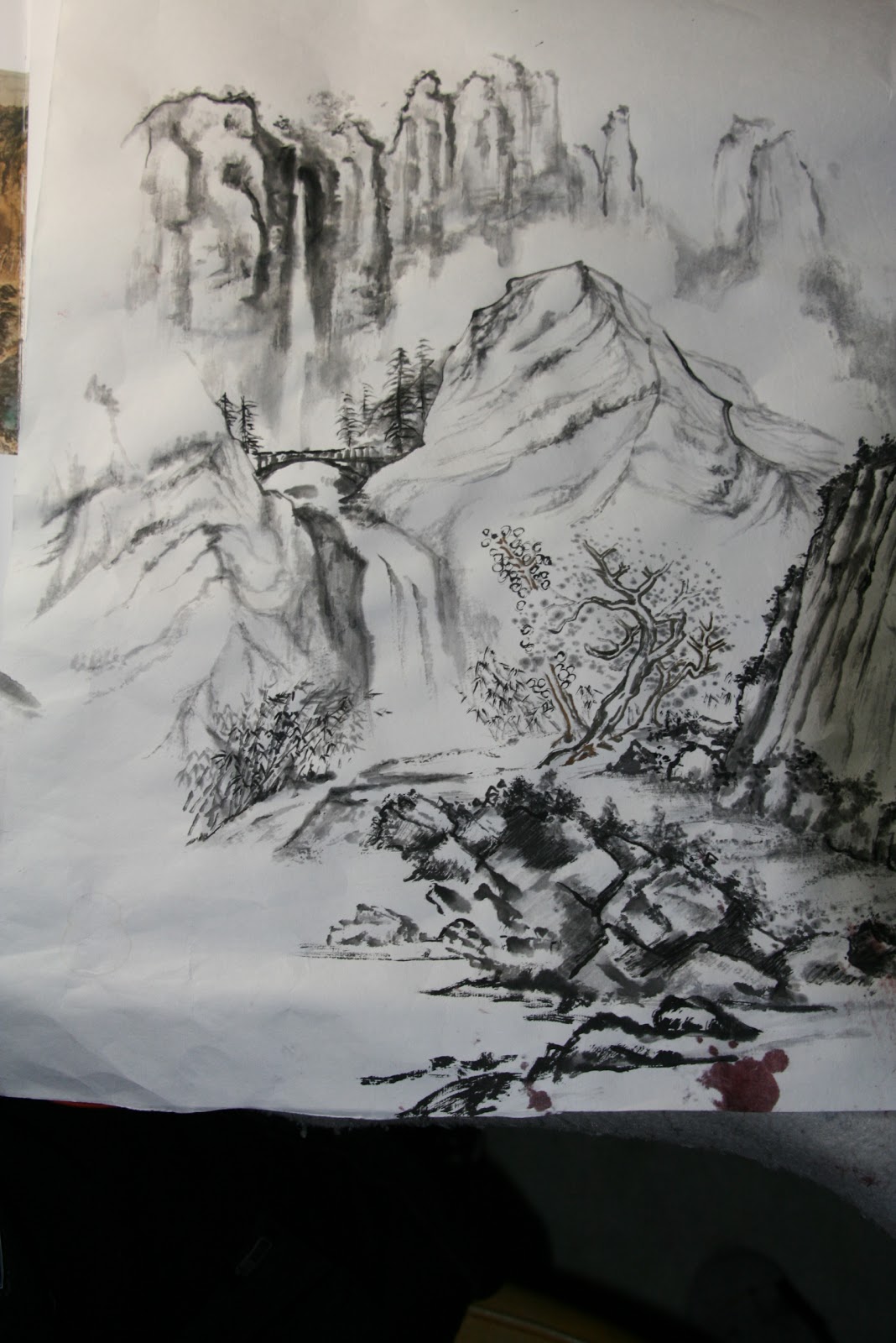
"Multnomah Fall" Chinese Style
It is no secret that I am not happy with my Multnomah Fall painting and have attempted some remodeling to the painting. Yet I am still bitten by the bug.
I've decided to try to depict the fall more as a presence than as a specimen. I employed simple lines.
I created 3 stages, the near, the middle and the far. The learn by rote training came into play. It wasn't too difficult to snatch different scenes from repeated practices.
The near scene enjoys the darkest lines and is shacked with the most details. Trees are done in the outlined style, sort of. The middle stage cradles the bridge and the lower fall, which then empties into the creek. The far scene is staged by the upper fall, flanked by sentinels of straight cliffs. The fog and mists at the bottom of these cliffs are used to push them way back, further away from the rest of the masses. I should note that in the original draft, I felt the width of the lower fall was too wide. I cleverly turned the right edge of the lower fall into a steep embankment, effectively narrowing the spillway.
I kept the color scheme simple. The indigo blue was used mainly for effect. The cold color helped to foster distance, yet adding punch to the painting.
I did the frame a little different from the traditional way. Instead of an assembly of 4 sides, I skillsawed an opening into a plank of pine to accommodate the canvas. The pine is finished in gold to render an "antique" look.
This piece was submitted to a Calligraphy and Painting competition hosted by the Confucius Institute.
Whereas I have not received any notices from the Institute, I am very happy to see my work poted as the promotional piece on their main page under the C and P category.
http://promotion2011.chinese.cn/index.php
I've decided to try to depict the fall more as a presence than as a specimen. I employed simple lines.
I created 3 stages, the near, the middle and the far. The learn by rote training came into play. It wasn't too difficult to snatch different scenes from repeated practices.
The near scene enjoys the darkest lines and is shacked with the most details. Trees are done in the outlined style, sort of. The middle stage cradles the bridge and the lower fall, which then empties into the creek. The far scene is staged by the upper fall, flanked by sentinels of straight cliffs. The fog and mists at the bottom of these cliffs are used to push them way back, further away from the rest of the masses. I should note that in the original draft, I felt the width of the lower fall was too wide. I cleverly turned the right edge of the lower fall into a steep embankment, effectively narrowing the spillway.
I kept the color scheme simple. The indigo blue was used mainly for effect. The cold color helped to foster distance, yet adding punch to the painting.
I did the frame a little different from the traditional way. Instead of an assembly of 4 sides, I skillsawed an opening into a plank of pine to accommodate the canvas. The pine is finished in gold to render an "antique" look.
This piece was submitted to a Calligraphy and Painting competition hosted by the Confucius Institute.
Whereas I have not received any notices from the Institute, I am very happy to see my work poted as the promotional piece on their main page under the C and P category.
http://promotion2011.chinese.cn/index.php
Wednesday, June 29, 2011
Pear Flower
I must have stared at my Chinese Pear trees for the last 10 years, each year contemplating whether to thin the pear blossoms or not. I was told thinning the blossoms will give me bigger pears. As it is my pears are tiny, but abundant. In fact so many of them fell to the ground each year that it seemed such a waste.
Fortunately the Canadian geese have developed a taste for them now and they are helping themselves to juicy (fermented?) pears on the ground in the Fall.
This year I decided to paint my Pear blossom, ala En Plein Air. As I am also studying Chinese calligraphy, I thought it would opportune myself to "write" each petal. I would attempt to write each blossom with my Chinese brush, with infinite patience, and observation, and different brush strokes.
I am also doing this painting on my calligraphy paper. I was told this paper is made of bamboo fibers and is colored yellow. Not unlike the toilet papers that I remembered growing up. The paper is very absorbent and "honest", in that it captures faithfully your brush stroke. Unlike ordinary Xuan, it is not good in recording shades of grey, but it excels in reporting the sharp edges and streaks rendered by your brush.
I picked this subject matter because each petal is akin to writing a "dot" in Chinese calligraphy. Not necessary round, but some requires you to hide the tip, while others demands a parade of tips and hooks and twists. Intriguing indeed. Thus I spent quite a few days, sitting in the backyard, painting on my picnic table. A tedious process, for I am not a patient individual. A rewarding process, for the finished work is one that I could be proud of.
Fortunately the Canadian geese have developed a taste for them now and they are helping themselves to juicy (fermented?) pears on the ground in the Fall.
This year I decided to paint my Pear blossom, ala En Plein Air. As I am also studying Chinese calligraphy, I thought it would opportune myself to "write" each petal. I would attempt to write each blossom with my Chinese brush, with infinite patience, and observation, and different brush strokes.
I am also doing this painting on my calligraphy paper. I was told this paper is made of bamboo fibers and is colored yellow. Not unlike the toilet papers that I remembered growing up. The paper is very absorbent and "honest", in that it captures faithfully your brush stroke. Unlike ordinary Xuan, it is not good in recording shades of grey, but it excels in reporting the sharp edges and streaks rendered by your brush.
I picked this subject matter because each petal is akin to writing a "dot" in Chinese calligraphy. Not necessary round, but some requires you to hide the tip, while others demands a parade of tips and hooks and twists. Intriguing indeed. Thus I spent quite a few days, sitting in the backyard, painting on my picnic table. A tedious process, for I am not a patient individual. A rewarding process, for the finished work is one that I could be proud of.
Finished painting is 16 in x 16 in, mounted on Canvas, ala Xuan-Boo style.
Saturday, June 25, 2011
Etude
Examples of Landscape practice pieces. I intend to use some of these as instructional materail. Why not? Write a blog and be able to use it for teaching...... I guess this is what you would call killing two birds with one stone.
Friday, June 24, 2011
Gou, Chuen, Ts'a, R'an
Gou, Chuen, Ts'a, R'an are the 4 required elements to execute a Chinese brush landscape painting.
This is a continuation of my last 2 blogs; "Stone Paper Scissors" where we tried to make sense of all the lines that are associated with rocks and mountains, and " What Chuen" where we delved into the application of texture to the object.
The loose translation for these 4 elements are as follows:
Gou means to outline, to scribe. This is the process when we lay down the initial outline of the landscape. The requirement for this element is that the line must not be "drawn", and must be "written." The line must possess the quality of change, from start to finish. The viewer has to be able to feel the variations in brush speed, pressure, center or side tip. Hence "GOU" carries the connotation of not tracing but etching and carving.

After we have the outline done, it is time to garnish it with "Chuen" and this is the process when we can provide a qualitative description of the texture of the landscape. In this particular example, I've used mainly the "AXE" chuen and a little bit of the "HEMP" chuen.

After texture is provided, we provide the the painting with "Ts'a"
Ts'a means scrub or rub. This is when we used a very dry brush to rub the landscape to give it a general sense of texture. This texture is quite generic, unlike the more specific axe or hemp chuen.
The Ts'a process is often mingled with the Chuen process. As one is laying down the more specific texture, one can also add the non specific texture. In a way the Ts'a process can be deemed a prelude to shading. The important thing to remember is the Ts'a still requires the artist to follow brush strokes, paying attention to using either the tip or the belly of the brush, or both. This is definitely not a random, omnidirectional wild circles of shading.
The last element of landscape painting is R'an, which means to dye (wash), to shade. This is the time when we use a very diluted ink wash to accentuate the shaded areas of the landscape, to effect a more 3-dimensional presentation of the work. It is important to note that the R'an process must be done with patience. It is only after repeated attempts to selectively augment the strategic areas of the landscape, each time with different dilutions of the ink solution, does one succeed in a painting that is pleasing to the eye.
This patience has to be tethered with experience for the effort not to be futile. Xuan paper gives off a false and exaggerated saturation profile when wet. For beginners ( and impatient journeymen alike), the wet Xuan seems to function like an abyss, where it will take up a large amount of ink and showed little difference in the apparent "blackness" until it is irreversibly too late.
This is an example of a wet Xuan, The R'an seems more saturated than it really is, giving one a false sense of security.
The above picture is the same as the wet Xuan picture, except that now it has dried. As one can see, the really dark areas are no longer pitch black. Thus for those of us who are not patient, we will try to attain this with one step, one layer of R'an and that often ends up in overkill, and renders the painting rather unnatural.
At this point, some artist like to give the painting an overall wash, often times with the brush wash, to give the painting a more coordinated look. Many artists dislike this process, for it tends to take away the "punch" of the painting.
If one chooses to add color to the painting, now is the time. Color often is considered a distraction, and is typically not applied until the painting is deemed satisfactory and coud be presented as a black and white on its own merits.
Tuesday, May 10, 2011
What "Chuen"

Interestingly enough, when What "Chuen" is translated into Chinese and pronounced in the Cantonese dialect, pronounced "mud chuen", it carries the connotation of WTF......naughty, naughty.
After this tidbit of irrelevancy, let's get down to business and explore "chuen".
"Chuen" can be loosely translated as the act of applying texture to an object (could be tree trunks, rocks, hills etc.). Since the cardinal rule of brush painting says one should apply "chuen" more in the shaded areas, and since the manifestation of light values in classical Chinese Brush painting is less evident, a lot of people mistake "chuen" as the equivalent of shading.
Historically there are many different methods, or styles of "chuen", and "chuen" can be done with dots or lines. The different "chuen" imparts a different description of the object. Let us explore the more common ways of "chuen". Please refer to my last blog Stone, Paper, Scissors to see the relationship between "chuen" lines and contour lines.
First is the Hemp chuen. This is typically a dash initiated with a tapered point. Think of this as a hemp fiber, with one end kneaded and ready to be threaded through a needle.
An embellished version of this is the Unravelled Ribbon chuen. This can be best described as a bunch of Hemp chuen in close proximity to each other, as if a ball of ribbons of hemp fibers in unravelling.
The "chuen" can be done in any orientation... vertically, horizontally, sideways, etc.
Then we have the Lotus Leaf Vein chuen. As the name implies, this style mimics the veins of the lotus leaf. It is a effective way of animating the topography of a landscape, giving the viewer a perspective of the ridge tops and valleys and lobes.

Finally, we have the Axe chuen. This style is used to document straight line fractures, fissures commonly seen in granites or lime stone layers. Imagine swinging an axe into a hard surface. The resulting sharp edge and the splintering along the sharp edge defines this method of "chuen". It is done by using a dry ink brush laying on its belly with a sharp rubbing.
To witness how these different "chuen" are applied to a real painting, I like to borrow a magnum opus from the late Master Zhang Da-qian; his Lu Shan painting. (painting of Mt. Lu)
Please click on the pictures to enlarge them so you can see the pasted remarks.
The final picture below shows the segment of the painting where I borrowed as examples to illuminate the concept and application of "chuen".
Hopefully we have all gained a little bit of insight into contour lines and "chuen" lines by now, and we won't be uttering "what chuen" (tongue in cheek) when we are asked to write a landscape painting.
Subscribe to:
Posts (Atom)